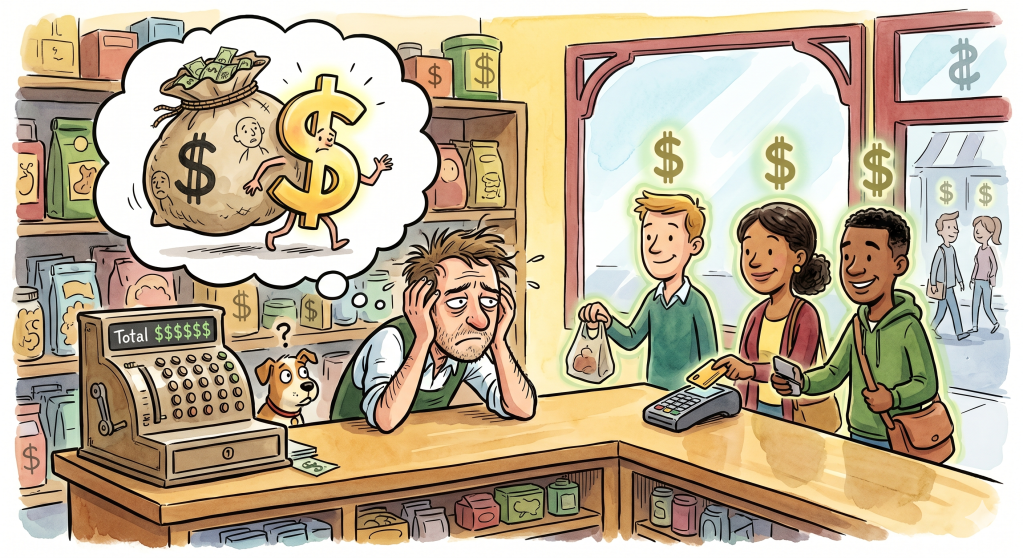
They are beginning to look like dollar signs. I am not sure if this is a good or a bad thing, or if it is a me problem or a them problem. A year ago, engaging with every person that came in was enjoyable. Two months ago, when the driveway alarm sounded, my eyes retreated up and back into my head. Today, when the doorbell rings, I think I am starting to hear cash register sounds. Not a loud sound; it’s like the sound of a mosquito on a late summer night. I know it’s there, but unless it flies next to my ear, I can’t pinpoint it.
It feels wrong to look at the people that visit and play as chumps that are only good for a dollar. To treat them like that feels wrong, and anything I say to them becomes a lie—not a lie in the deceiving way, but a lie in how genuine I am. This was punished as a youth. You weren’t just punished for lying, but for telling a disingenuous truth. It becomes the means to their end: the temptation to upsell them and squeeze out what they have in their pocket like toothpaste. The arrogance is present as well because I have the ability to do it. I can cheat with the best of them.
My ability to convince or persuade people is sneaky good, growing up in a household in which my ability to be a chameleon was a blessing and also a curse. The main question it presents to me at 40 is that of my identity. Most of the time I struggle to know who I am. In grade school, I was friends with many different groups. It was not uncommon to see me with jocks and in the next moment having lunch with the least popular. The ability to morph into what that group required came as second nature because at home pain was the reward for individuality.
I carry this with me now. If I am disingenuous people will know it, and they will inflict pain. The truth is people are uninterested or unconcerned with everything around them; they are more interested in themselves. I would estimate that my interactions with those that approach the counter make an impact less than three percent of the time. Does this make me a cynic? Do I have a continuously lowering view of my fellow man? Probably.
Finding the sweet spot for business client interactions is as tough as finding a tick on a polar bear while he mauls you. The moment you mention the relationship or attempt to analyze it, you are no longer in the confines of that relationship. It reminds me of C.S. Lewis’ thoughts on the Introspection Paradox. You cannot be in a boiling rage and also analyze that rage because the moment you begin to analyze, the rage begins to cool. This is the same difficulty in attempting to understand the interactions. Observing someone else’s or yours in retrospect is as close as you can get. At best, you either move to more or less cynical. You see more humans or more dollars. Moving myself along these imaginary lines is more in my control than I would like to admit. I suspect it takes effort to move up the line and resignation to move down.
At the end of it all, I don’t want to see people as money. I want to see them as human. I also don’t want to see them as an inconvenience. Well, maybe they are an inconvenience, and that is the point. To be convenient is to be comfortable and lack friction. So that means that inconvenience means uncomfortable and friction. Interesting.
Is making money done best when you are able to turn the inconvenience into convenience? And the best businesses not only eliminate inconvenience for their customers but also make it disappear for themselves. Maybe that is why customer service exists. The function was to transfer the inconveniences from the customer to the company. And the companies with the best customer service have the least number of therapy bills because the inconveniences are taken care of instead of left in a large heaping pile. That’s the job of business then: turning the inconveniences of people into convenience, while convincing them they are the hero.
 Nos & Rehtaf, Dnabsuh